

The truth about extractions in orthodontic treatment — and why the best outcome often depends on when you start.
If you or your child has been told that braces might require removing some teeth, it is natural to feel concerned. At Sonrisas Dental Center — serving Austin, Round Rock, South Austin, and Cedar Park — we believe every patient deserves a clear, honest explanation of why extractions may or may not be part of their treatment plan.
The short answer: sometimes extractions are the right choice, and sometimes they can be avoided entirely. The longer answer requires understanding how teeth, jaws, and airways all work together — and why starting orthodontic evaluations early can change the entire equation.
What Is Extraction vs. Non-Extraction Orthodontics?
In orthodontic treatment, “extraction” refers to the planned removal of one or more permanent teeth — most often premolars — to create space before or during braces or aligner therapy. “Non-extraction” treatment achieves alignment and proper bite without removing any permanent teeth, using techniques like palatal expansion, arch development, or strategic tooth movement.
Neither approach is universally right or wrong. The best choice depends on the patient’s age, the severity of crowding, jaw structure, airway health, and long-term facial aesthetics.
When Is Extraction the Right Choice?
There are clinical situations where extracting teeth is genuinely the most responsible path forward. Here are the main scenarios where we may recommend it:
Severe Crowding with No Room to Expand
When the upper or lower jaw is simply too small to accommodate all the teeth — and the bone and facial structure do not allow for meaningful expansion — removal of a premolar or two can provide the space needed to align everything properly.
Adult Patients with Fully Developed Jaws
Jaw growth is typically complete by the late teens. In adult patients, options like palatal expansion are no longer available because the midpalatal suture has fused. When expansion is off the table and crowding is significant, extraction becomes a viable and often preferable solution.
When Jaw Surgery Is Not an Option
In some cases, the ideal correction would involve orthognathic (jaw repositioning) surgery. But not every patient is a candidate — or willing to pursue surgery. In those situations, strategic extractions combined with careful orthodontic mechanics can still produce an excellent functional and aesthetic result.
Important clinical note: Extraction is not a shortcut. When we do remove teeth as part of orthodontic treatment, the mechanics of closing that space require careful planning. We are mindful of the impact on the airway, tongue space, and facial profile at every step of treatment. Our goal is not just straight teeth — it is a healthy, functional, long-lasting bite.
Pros and Cons of Extraction Orthodontics
Potential benefits:
- Creates room for severely crowded teeth
- Can improve lip position and facial profile
- Enables a stable, well-fitting bite
- May be the only non-surgical option for adults
- Improves long-term hygiene and tooth longevity
Considerations and risks:
- Permanently removes healthy teeth
- Can narrow the arch if space is not closed carefully
- Risk of compromising tongue space or airway if mechanics are not properly managed
- Not ideal when expansion or surgery is feasible
How Early Treatment Can Help You Avoid Extractions
Here is where the story changes — especially for children and adolescents. When patients come to us for an orthodontic evaluation between the ages of 7 and 10, we have a significant advantage: the jaws are still growing, and we can work with that growth rather than against it.
Widening the Palate to Create Space
A palatal expander gently widens the upper arch over several months, creating room for permanent teeth to erupt in the correct position. This is only possible while the midpalatal suture is still open — typically before age 13 to 14.
Improving Airway Development
A narrow palate and crowded arch are closely linked to airway restriction. By widening the palate early, we help open the nasal airway and create adequate space for the tongue to rest in a healthy position. This has benefits that extend far beyond straight teeth — better breathing, better sleep quality, and improved overall health.
Guiding Erupting Teeth Into the Correct Path
We monitor the eruption pattern of permanent teeth and intervene when a tooth is heading into a problematic position. This can prevent impactions, reduce the severity of crowding, and minimize the complexity of treatment needed later.
The American Association of Orthodontists recommends a first orthodontic evaluation by age 7. We echo that recommendation — not to rush treatment, but to identify patients who would benefit from early guidance before the window of opportunity closes.

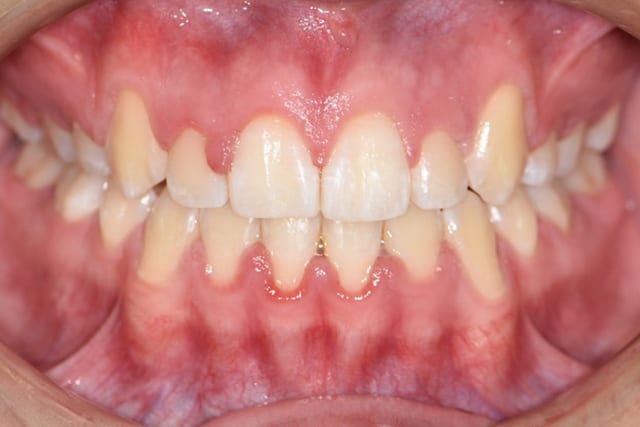
Patient Case Study
Severe crowding at age 14 — a successful extraction case
This patient first came to Sonrisas Dental Center at age 14 with severe crowding in both arches. Because growth was nearly complete and expansion alone was not sufficient to address the degree of crowding, we recommended the removal of several premolars to create adequate space for the remaining teeth.
The results speak for themselves. After completing treatment, the patient achieved a beautiful, functional bite with excellent occlusion — meaning the upper and lower teeth fit together precisely as they should. More importantly, with all remaining teeth properly positioned, the patient now has the space needed to clean effectively between every tooth, dramatically improving long-term dental health and reducing the risk of decay and gum disease for decades to come.
Our Philosophy at Sonrisas Dental Center
We are a bilingual, multi-specialty dental group with locations in Round Rock, South Austin, and Cedar Park. Orthodontics is one of our core services, and we approach every case with the same commitment: to recommend only what is truly in the patient’s best long-term interest.
That means we never rush to extract when expansion is possible. It also means we do not avoid extractions when they are genuinely the right answer. What it always means is that we explain our reasoning clearly, answer every question — in English or in Spanish — and make sure you feel confident in your treatment plan before we begin.
Ready to Find Out What’s Right for Your Smile?
Free orthodontic consultations available at all three Austin-area locations. Se habla español.
Frequently Asked Questions
Do braces always require tooth extractions?
No. Many patients achieve a beautifully aligned smile without losing any permanent teeth. Whether extractions are needed depends on age, the severity of crowding, and whether expansion is still possible. Patients who begin orthodontic evaluation by age 7 often have more options available to them.
Does extracting teeth for braces affect breathing or the airway?
This is an important concern we take seriously. Our orthodontists carefully manage the mechanics of space closure to maintain adequate tongue space and protect the airway throughout treatment.
At what age should my child have a first orthodontic evaluation?
By age 7, according to the American Association of Orthodontists. Early evaluation allows us to identify problems with jaw development and tooth eruption while there is still time to address them effectively.
Is palatal expansion available for adults?
Traditional palatal expansion is generally not possible in adults because the palatal suture has fused. This is one reason early evaluation is so valuable — it preserves options that are no longer available after growth is complete.
Where can I get braces in the Austin area?
Sonrisas Dental Center offers orthodontic treatment at three Austin-area locations: Round Rock, South Austin, and Cedar Park. We offer free consultations and bilingual care. Se habla español.